

agents and MCP
Tool calls protected both ways.
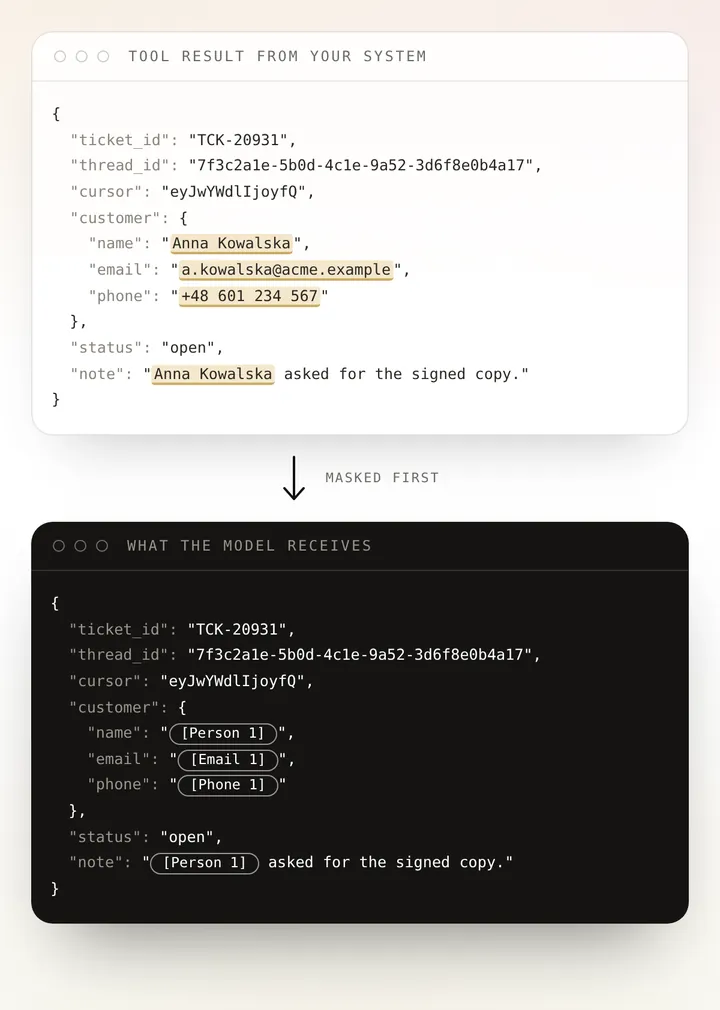
An agent reads more personal data than any person types: every ticket, record and thread its tools return. OBVELO masks a tool result before the model reads it, puts the real values back into the arguments before your systems receive them, and leaves the ticket ids, thread ids and cursors exactly as they were, so the loop keeps working.
ways in
Wherever your agent talks to a model or a tool
proxy
Change the base URL
Point an OpenAI, Anthropic, Gemini or Mistral client at the gateway. Every message and tool result in the request is masked before it is forwarded, files follow your account’s file policy, and the model's answer comes back with the real values. You keep your own model provider, contract and key; the gateway forwards your credentials and never calls a model on its own. Proxy docs.
tool gateway
Between the agent and your MCP server
Results from your systems come back masked, names included; arguments the model writes are restored before they reach your system, so a search for a tokenised name still finds the right record. Your account's tool allowlist is applied before any call goes out. The gateway reaches your MCP server through a separate egress relay that connects only to public HTTPS addresses, checks every address the name resolves to, and follows no redirect. It is set up with us: ask through the contact form.
connector
Masking as a tool in any MCP client
A small program on your own machine gives Claude Desktop, Cursor or any MCP client tools to mask, inspect and restore. It speaks HTTPS to the gateway and to nothing else, and keeps the session's map in memory only. Download it.
API
Any JSON, one person one token
Send a tool result as object to /v1/mask: values are masked field by field and structural keys stay untouched. The answer carries the map; send it back with the next call and the same person keeps the same token across the whole task. Our hosted service stores nothing from request content — the state travels with the request. API docs.
your controls
Set per account, or per key
tools
An allowlist the model never sees past
With an allowlist, a call to any other tool is refused before it reaches your server, and the tool list the model receives is filtered to the same set. Every governed action is recorded without its content: the tool, the decision and the time it took.
profiles
A profile for every agent
A prospecting agent and a claims agent need different rules. Each key can carry its own agent profile — jurisdictions, rules, model mode — and the profile belongs to the key, not to a request header, so a caller cannot switch it.
restore
Decide who may see the real values
A key can be allowed to restore everything, nothing, or only the categories you name. A key that may not restore receives its map sealed: the gateway can open it on the next call, so tokens stay consistent, and nobody else can. Every restore decision is recorded without its content — which surface, what was decided, how many values of each category.
lock
Requests may ask for more masking, never less
Lock the masking of an account or a key, and a request that asks to mask less than the account set — fewer countries, rules switched off, a weaker profile — is refused with the field it named. Asking for more is always allowed.
fail closed
A refusal, never a value in clear
When the name model in use does not answer, the request is refused with a hint — nothing is forwarded, billed or handed back. A key whose map must be sealed is refused on a gateway that cannot seal it, rather than given the map in clear.
measured
Agent loops, and somebody else's documents through every agent surface.
975
agent loops: 65 scenarios from the systems agents connect to, through 5 model APIs, in 3 payload shapes
0
of 2 025 personal values reached the model
0
of 3 315 ids, threads and cursors changed — 0 payloads restored wrong
10 000
documents through 7 agent surfaces: 50 000 agent runs and 20 000 MCP runs
agent loops: our own invented payloads · rule layer
agent surfaces: held-out test split of Nemotron-PII, never used for tuning · 272 594 personal values, each surface judged against the same document masked as plain text, no value it masks left in clear · 3 requests refused instead of answered · rule layer
where it applies
The traffic that passes through it
the path
Proxy for a guarantee
The gateway masks what passes through it. A connector is a tool the model chooses to call; where masking has to be guaranteed, route the agent's model traffic through the proxy, which it cannot go around. What a person types into a chat window is the browser add-on's work.
the provider
Your model, your contract
The model provider is the one you choose, under your own contract and with your own key. It receives the masked request; the real values stay with you and come back only where a key may restore them.
your code
A sealed map stays sealed
The SDKs restore a plain map on your side. A key whose map is sealed restores through the gateway, where its policy applies; the SDK says so instead of restoring locally.
Let the agent work. Keep the people out of the prompt.
Building an agent on your own systems? Tell us which tools it calls.